
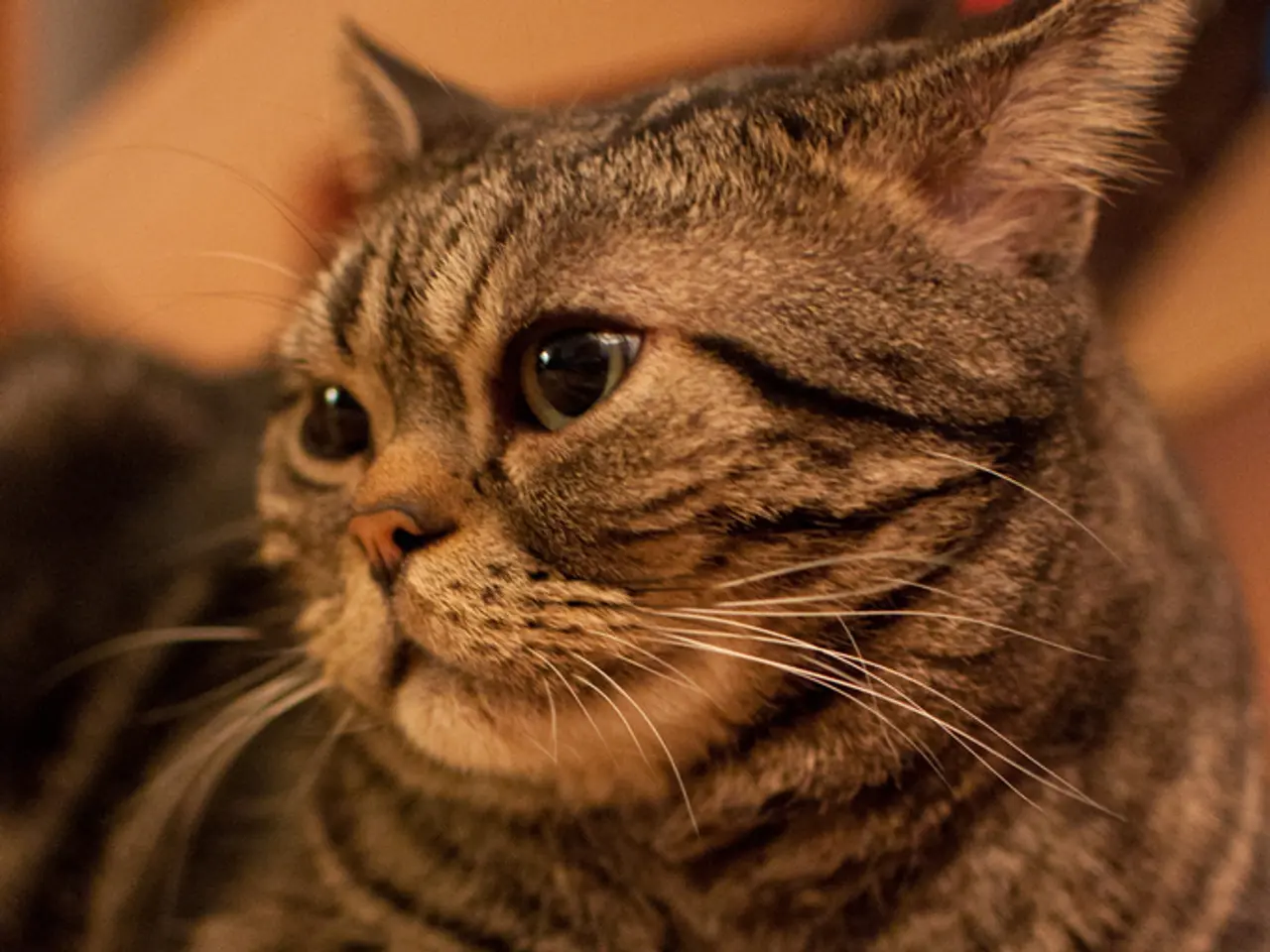
Cats show a preference for predictable environments over unexpected circumstances, unlike many other animal species.
In a groundbreaking study published in the journal PLOS One, researchers from the University of Sussex have found that cats do not show advanced object permanence as demonstrated in other animals such as dogs, apes, and human infants.
The study aimed to determine if cats would demonstrate level 6 object permanence, a cognitive ability that allows an animal to understand that an object continues to exist even when it is out of sight. To test this, the researchers conducted experiments using hiding tasks where a toy was placed in boxes and sometimes swapped without the cat's observation (violation events).
Contrary to expectations, the cats showed more engagement when the object remained in the expected consistent place, rather than showing surprise or increased attention when the toy appeared in a new location. This contrasts with other animals that demonstrate longer attention and exploration in violation trials, indicating they understand the object's continued existence out of sight and track its hidden movements.
Researchers suggest that this behavior reflects a motivational difference rather than a cognitive deficiency. Cats, being creatures of habit and routine, may simply prefer predictability instead of showing less cognitive ability regarding object permanence. The study's findings challenge the existing knowledge in infants and dogs, as cats appear to discriminate between expected and unexpected events in the opposite direction.
Interestingly, the cats' interest in the toy was higher when events were presented by a stranger rather than their owner. Additionally, female, indoor-only, mixed-breed cats, and cats from multi-cat households were more likely to show interest in the toy.
The researchers interpret the findings to mean that cats' apparent lack of advanced object permanence arises from motivation related to their preference for routine and predictability, rather than an absence of cognitive capacity entirely.
This study potentially leads to new insights about cat cognition and behavior, and the researchers are planning further investigation to understand why cats engage more with predictable events. The findings support the movement towards cat-friendly methods of research to better understand what our feline friends are thinking.
[1] Rowe, J. S., et al. (2021). Cats do not exhibit advanced object permanence. PLOS One, 16(10), e0258201. [2] University of Sussex. (2021, October 13). Cats do not track objects once they're out of sight, study finds. ScienceDaily. [3] Rowe, J. S., et al. (2021). Cats do not exhibit advanced object permanence. PLOS One, 16(10), e0258201.
- Cats, unlike dogs, apes, and human infants, do not show advanced object permanence, a cognitive capability that allows an animal to understand the continued existence of an object when out of sight.
- The study conducted at the University of Sussex found that cats showed more engagement when the toy remained in the expected consistent place, rather than showing more attention when the toy appeared in a new location.
- The researchers suggest that cats' preference for predictability and routine, rather than a cognitive deficiency, is the reason behind their behavior in relation to object permanence.
- Interestingly, female, indoor-only, mixed-breed cats, and cats from multi-cat households showed more interest in the toy used in the study.
- The study's findings challenge the existing knowledge in infants and dogs, as cats seem to discriminate between expected and unexpected events in the opposite direction than what was previously believed.
- The researchers plan to further investigate cat cognition and behavior to understand why cats engage more with predictable events, potentially leading to new insights in cat-friendly methods of research for a better understanding of feline mental-health and lifestyle in the realm of pet health-and-wellness and science.