
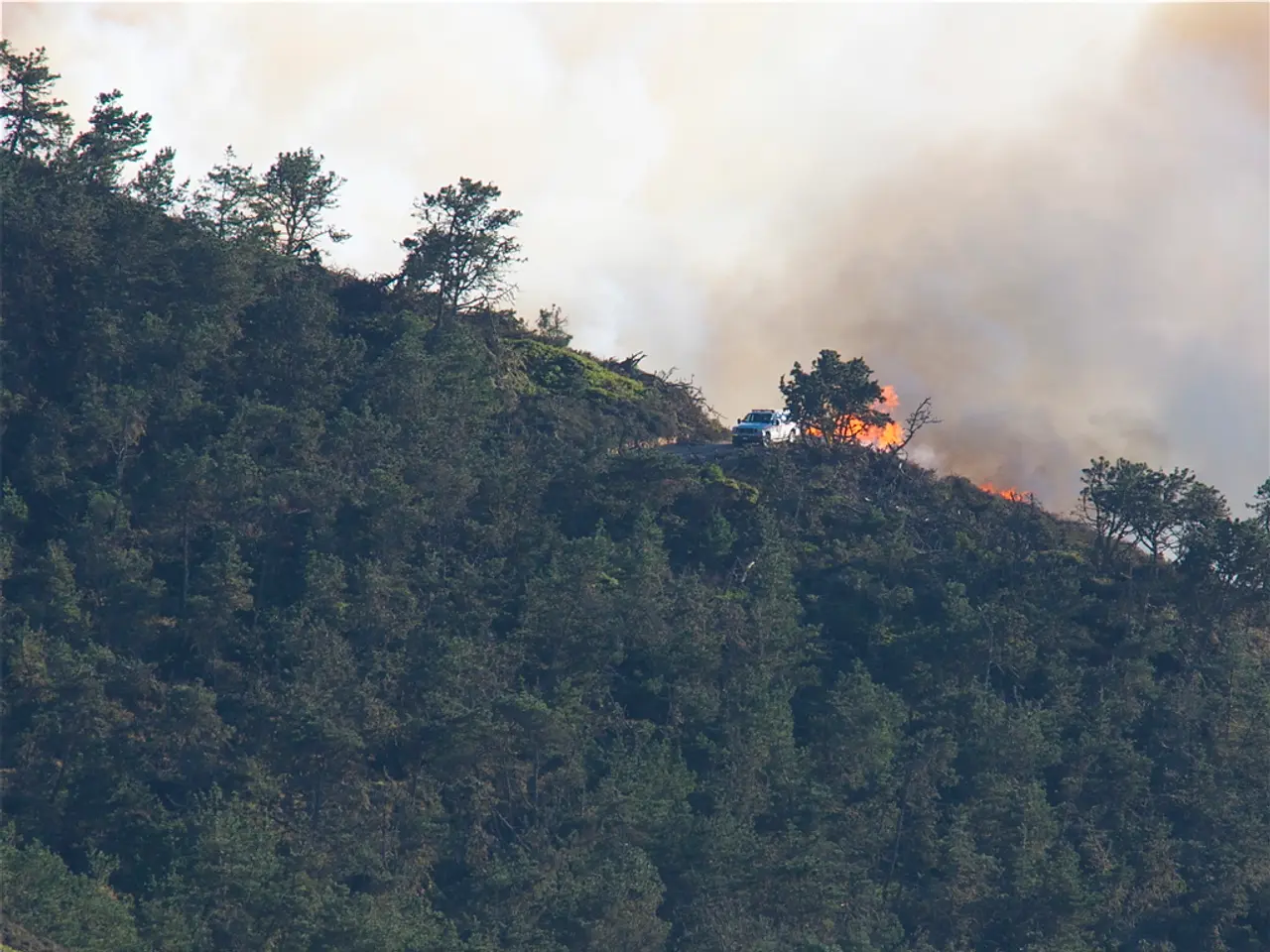
Smog from Wildfires Inflicts Discomfort Across Canada and the U.S., Issuing Air Pollution Warnings
Canada's Unprecedented Wildfire Season of 2025
In August 2025, Canada is grappling with one of its worst wildfire seasons on record, with over 700 active fires burning across the country. On Tuesday, August 5, eight more wildfires sparked to life, according to the Canadian Interagency Forest Fire Centre (CIFFC).
The unprecedented wildfire season is primarily attributed to climate change, which has created environmental conditions conducive to extreme wildfire incidence and intensity. Higher temperatures, drier conditions, and earlier warming leading to prolonged drought have increased the fuel for fires, resulting in more frequent, severe, and longer-lasting blazes.
Rising global temperatures contribute to these conditions by drying out soils, trees, and grasses, making forests and wildlands more flammable. Earlier spring warm-ups reduce snowpack gradually soaking the soil, leading instead to rapid snowmelt on frozen ground, causing evaporation and drought conditions. Extended fire seasons are a consequence of warmer weather beginning earlier and lasting later into the year.
Moreover, the vulnerability of boreal forests in early spring, when deciduous trees lack leaves to retain moisture, increases the likelihood of fire ignition and spread. This, coupled with the increased frequency of both human-caused fires (in spring) and natural fires triggered by lightning (in summer), has exacerbated the wildfire situation.
One particularly concerning aspect of this year's wildfire season is the phenomenon of "zombie fires" – fires from previous years that survived under snow and reignited. This has caused hundreds of new wildfires in early 2025, particularly in Alberta and British Columbia.
The smoke from these massive wildfires has caused hazardous air quality and widespread health issues over large regions in Canada and the northern United States during the summer of 2025. Many cities in these regions are experiencing "high risk" or "very high risk" air quality conditions.
Air quality alerts indicate that the air is unhealthy for sensitive groups, including people with asthma, lung or heart disease, children, and older adults. The National Weather Service (NWS) has issued air quality alerts across the Midwest and Northeast, with several alerts covering entire states.
Experts have warned that Canada's 2025 wildfire season is on track to rival the severe 2023 season. Yan Boulanger, research scientist in forest ecology at Natural Resources Canada, stated in 2024 that climate change is increasing the flammability of wildfire fuel.
Monica Vaswani, a warning preparedness meteorologist at Environment Canada, stated that this situation is becoming more common. Federal officials have issued air quality warnings across large swaths of Saskatwan, Manitoba, and western Ontario. Environment Canada predicts these conditions may persist through the end of the week.
The only way to truly extinguish this ongoing crisis is to eliminate the fuel: greenhouse gas emissions. As the planet warms, intensifying wildfire seasons will continue to smash records not just in Canada, but around the world.
- Gizmodo reported on the alarming rise in earth-science related news, focusing on Canada's 2025 wildfire season, which is attributed to climate change, a concern in general-news and environmental-science.
- The technology of predicting and monitoring wildfires has become crucial, as the number of active fires in 2025 exceeded 700, a record-breaking incident for Canada's wildfire history.
- Health-and-wellness professionals have raised concerns about the impact of the 2025 wildfires on mental health due to continuous exposure to smoke-filled environments and the resulting air quality issues.
- As the future unfolds,stakeholders in science, earth-science, and environmental-science fields suggest that countries should invest in research aimed at mitigating the effects of climate change on wildfire frequency and intensity.
- In an effort to ensure the safety of residents in affected areas, organizations like the Canadian Interagency Forest Fire Centre (CIFFC) and the National Weather Service (NWS) provide updates on air quality, advising the public on protective measures and potential health risks associated with the ongoing wildfire season.